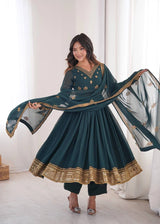
12 Types of Embroidery Stitches Blouse Lovers Should Know
You don't need to be able to do the stitches yourself to benefit from knowing them. Understanding the difference between a chain stitch and a satin stitch changes how you read a blouse, how you evaluate its quality, and how you know whether the price tag is justified.
These 12 types of embroidery stitches are the foundation of almost every Indian ethnic blouse you'll encounter, from casual cotton daywear to heavy bridal Zardozi pieces. Learn them once, and you'll carry the knowledge into every ethnic wear purchase you ever make.
Why Do Stitches Determine Price and Quality?
More than 40% of consumers globally now prefer embroidered garments specifically because of their unique, aesthetically detailed appeal. But what most buyers don't realise is that two blouses described as 'embroidered' can differ dramatically in the quality, durability, and time investment behind the work.
The difference almost always lives in the stitch. A chain stitch done by a skilled Aari worker is structurally stronger and more visually consistent than the same chain stitch done by a machine at high speed on a cheap base fabric. A satin stitch blouse that's been properly backed will hold its sheen for years; one that hasn't been backed will begin to pucker after two washes.
Here's the embroidery stitch guide you actually need.
Top 12 Best Types of Embroidery Stitches Blouse Lovers Should Know

If you want to take total creative control of your wardrobe and elevate your ethnic wear, knowing these twelve fundamental embroidery stitches will completely change how you design your next blouse.
1. Running Stitch
What It Does
The running stitch is the most fundamental of all hand stitch types. The needle passes in and out of the fabric at regular intervals, creating a dashed line of visible stitches with gaps between them. It sounds simple, and the individual stitch is, but the art of running stitch lies in its density and layering.
On Blouses
Running stitch is the foundation of Kantha embroidery. When laid in tight, dense rows across a fabric surface, it creates a textured all-over pattern that looks almost like quilting. On blouses, you'll see it used for geometric border patterns, all-over 'muted' coverage on casual pieces, and as a structural layer beneath other stitches.
Quality Check
Look for consistent stitch length and even spacing. Irregular running stitches on a Kantha blouse suggest rushed production.
2. Satin Stitch
What It Does
Satin stitch covers a fabric area completely with parallel straight stitches placed close together, edge to edge. The result is a smooth, fully-filled surface that resembles actual satin fabric, which is exactly where the name comes from. The direction of the stitches determines how light catches the surface and how the finished motif reads from different angles.
On Blouses
Satin stitch is used to fill the bodies of floral motifs, petals, leaves, and solid geometric shapes. It's the primary fill stitch in Resham silk thread work. A well-made satin stitch blouse will have motifs that look almost painted, with no fabric visible between thread lines. Gaps or loose threads in satin stitch areas are an immediate quality concern.
Quality Check
Run your fingertip across the satin stitch surface; it should feel smooth and slightly raised, with no gaps or pulls. If the stitches snag, the thread tension is inconsistent.
3. Chain Stitch
What It Does
Chain stitch creates a series of connected loops, each one anchoring the next, forming a flexible, rope-like line. It's structurally one of the strongest hand embroidery stitches; unlike the running stitch, the chain stitch distributes tension across multiple loops, which makes it resistant to unravelling from a single break point.
On Blouses
Chain stitch is the primary stitch of Aari embroidery, where the hooked needle creates continuous, smooth chain lines at speed across the fabric front. It's used to outline motifs, build dense floral fills, create text and date embroidery, and form the looped structure of traditional Kashmiri Sozni work. Blouse embroidery stitches in the Aari tradition are almost entirely chain-based.
Quality Check
Well-made chain stitches are uniform in size and tension. If one loop breaks, check whether the damage unravels further; high-quality chain stitch should stop. If more than two loops break from a single snag, the thread gauge or tension was incorrect.
4. French Knot
What It Does
The French knot is made by wrapping the thread around the needle a set number of times, typically one to three, and then pulling the needle back through the fabric at the same point, creating a small raised dot of thread on the fabric surface. The more wraps, the larger and more raised the knot.
On Blouses
French knots appear as flower centres in floral embroidery, as scattered dot patterns across blouse bodies, and clustered together to create the velvet-like textural fills you see in some Chikankari and Parsi Gara work. The raised dimension of French knots is what gives some embroidered blouses that three-dimensional quality when seen from close range.
Quality Check
Touch individual French knots; they should feel firm and rounded, not flat. Flattened French knots have been made with insufficient thread wraps or pulled through incorrectly.
5. Stem Stitch
What It Does
Stem stitch creates a smooth, continuous line that follows a curve cleanly. Each individual stitch slightly overlaps the previous one, creating a rope-like appearance when pulled tight. The name comes from its traditional use in embroidering plant stems; it's the stitch that makes curved vines and tendrils look elegant rather than jagged.
On Blouses
Stem stitch appears in the vine and tendril work of Aari and Chikankari embroidery, in the outline work that defines the edges of motifs before they're filled in, and in script embroidery where curved letterforms need smooth lines. Most blouses with a 'flowing' line quality in their embroidery use stem stitch for that effect.
6. Cross-Stitch
What It Does
Cross-stitch creates X-shaped stitches by working two straight stitches across each other at right angles. It's worked on even-weave fabric where the thread count allows the embroiderer to count stitches precisely and build geometric patterns and pixel-like images.
On Blouses
Cross-stitch appears on folk-inspired blouses, particularly in Rajasthani and Gujarati regional traditions. The geometric constraint of the X-shape naturally produces angular, symmetric patterns, which are exactly the kind of motifs that characterise those regional aesthetics. You'll also see cross-stitch on custom blouses where names, initials, or dates are embroidered.
7. Backstitch
What It Does
Backstitch creates a solid, unbroken line by stitching backward; each new stitch begins at the end point of the previous stitch rather than leaving a gap. It's the strongest hand-sewn line stitch, used in garment construction as well as embroidery, and creates a clean, precise outline.
On Blouses
Backstitch often works as a structural outline stitch beneath the decorative embroidery you actually see on a blouse. Before complex motifs are filled with satin stitch or French knots, the shape is typically backstitched as a guide and anchor. On some folk blouses, backstitch itself is the visible embroidery, creating clean geometric line drawings across the fabric.
8. Lazy Daisy Stitch
What It Does
Lazy daisy is a detached chain stitch; each petal or leaf form is an individual chain loop anchored at its tip. A group of five or six lazy daisy stitches arranged around a centre point creates a flower shape instantly, which explains the name. It's the fastest way to hand-embroider floral motifs.
On Blouses
Lazy daisy appears on casual cotton blouses with scattered floral patterns, on lightweight summer kurta blouses, and on children's ethnic wear where speed of production matters as much as visual impact. It creates a charm and informality that suits everyday pieces better than formal occasion wear.
9. Blanket Stitch
What It Does
Blanket stitch runs along the edge of fabric, looping around the cut edge with each stitch to create both a decorative border and a structural edge finish. Historically, it was the stitch used to finish the edges of woollen blankets, hence the name. When worked in a controlled, dense pattern, it creates a strong visual border.
On Blouses
Blanket stitch is the stitch that holds each mirror in place in Shisha (mirror work) embroidery. The looped thread creates a circular frame around each mirror, securing it to the fabric without piercing the mirror itself. Without the blanket stitch framework, the mirrors would fall out with normal wear.
10. Feather Stitch
What It Does
Feather stitch creates a branching, irregular line; one stitch goes left, the next goes right, and together they create a fern-frond or feather shape. It's a free, organic stitch that suits naturalistic designs where precision would actually work against the aesthetic.
On Blouses
Feather stitch appears on boho-style blouses, on free-form botanical embroidery on cotton pieces, and on casual Kantha-adjacent blouses where the loose, organic quality of the stitch adds character rather than detracting from it. It's not commonly used on formal or bridal pieces.
11. Herringbone Stitch
What It Does
Herringbone stitch creates a zigzag pattern between two parallel lines, one stitch goes up-right, the next comes down-right, creating the same visual rhythm as herringbone fabric weave. It works as both a fill stitch for geometric shapes and as a border stitch.
On Blouses
Herringbone is particularly common in South Indian embroidery traditions, where the angular repeat pattern suits temple-inspired geometric motifs. It also appears as a decorative border stitch on the neck and cuff bands of formal blouses, where the precise geometry reads as considered rather than casual.
12. Couching
What It Does
Couching lays a thick, heavy thread or cord on the fabric surface and secures it with small, perpendicular stitches placed across it at regular intervals. The couched thread creates the shape; the tiny stitches hold it flat. This is how metallic wire and cord are applied in Zardozi embroidery; the wire can't be pulled through the fabric without damaging it, so it's couched on top.
On Blouses
Couching is the defining technique of Zardozi and heavy metallic embroidery. The thick cord outlines give Zardozi its characteristic raised, defined motif edges. You'll also see couching in contemporary blouses where thick silk cord is used to create bold, graphic outlines over a base of regular embroidery.
How These Stitches Combine on a Single Blouse?
A Real Example: An Aari Bridal Blouse
A well-made Aari bridal blouse will typically use at least four of these stitches in combination:
- Chain stitch: primary Aari stitch for all motif outlines and vine patterns.
- Satin stitch: fills leaf and petal bodies with smooth colour coverage.
- French knots: flower centres and scattered seed textures throughout.
- Couching: metallic wire or cord outlines on the most prominent motif edges.
Each stitch serves a different functional purpose. Remove any one of them and the finished piece looks incomplete.
Using This Knowledge to Evaluate Quality
The next time you're looking at an embroidered blouse, ask these three questions:
- Are the satin stitch fills smooth with no visible gaps? (If not, the thread tension was inconsistent).
- Are the chain stitch lines even in size and loop spacing? (Irregular loops suggest machine work, not hand work).
- Do the French knots feel firm and raised? (Flat knots indicate insufficient thread wraps or pulled tension).
These three checks take thirty seconds. They'll tell you more about the quality of any blouse embroidery stitches than the label ever will.
For the full picture of how these stitches build into complete embroidery styles, read our guide to 15 types of embroidery for blouses. And when you're ready to shop, browse our embroidery blouse designs, each one hand-examined for the stitch quality described here.
Conclusion
Knowing the types of embroidery stitches behind a blouse is the fastest path from being a passive shopper to being a confident buyer. The embroidery stitch guide above isn't exhaustive; embroiderers use dozens of stitches across traditions, but these 12 cover the techniques behind nearly every Indian ethnic blouse you'll come across. Use this knowledge. It's the kind that doesn't go out of fashion.