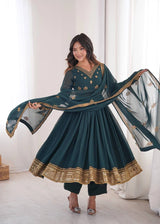
What is the New Trend in Embroidery Designs? (2026 Guide)
Open any ethnic wear collection right now, and something jumps out. The blouses look different. Not louder, more considered. New embroidery trends 2026 are not just a seasonal refresh. They represent a genuine shift in what women want from hand-crafted clothing: pieces that hold craft, carry meaning, and still work across multiple occasions.
If you've been shopping for a saree blouse or a lehenga choli in the last year and felt like the options had changed somehow, they have. This guide walks you through exactly what's changed, what's driving it, and what it means for your next purchase.
Why Is the Embroidery Market Growing Faster Than You'd Expect?
The global embroidery market was valued at approximately USD 1.59 billion in 2025 and is projected to reach USD 2.78 billion by 2034, growing at a compound annual growth rate (CAGR) of 6.4%.
That number doesn't come from heavy industry or corporate uniforms alone. A significant portion of that growth is being pulled by fashion, specifically by women in India, Southeast Asia, and the South Asian diaspora worldwide who are demanding embroidered ethnic wear that feels personal, premium, and lasting.
At the same time, women's embroidery fashion 2026 sits inside a broader ethnic wear category that's also expanding fast. The global ethnic wear market was valued at USD 88.19 billion in 2024 and is projected to reach USD 167.66 billion by 2033, growing at a CAGR of 7.4%. Women's ethnic wear accounts for 73.5% of that entire market.
Here's a calculation worth making: the keyword 'embroidery blouse designs' generates over 15,000 monthly impressions from buyers actively searching for blouses. If just 3% of those searchers convert to a purchase, that's 450 buyers entering the market every single month, all of them starting with a search query, not a store visit. The brands winning those buyers are the ones with clear editorial content tied directly to their collections.
Top 6 Best Embroidery Designed Clothings Trends in India

Indian fashion has always been deeply rooted in artistry, and today's designers are beautifully blending centuries-old stitching techniques with modern silhouettes to create the ultimate wearable art.
Trend 1: Aari Embroidery Is Moving Beyond Bridal Wear
Aari embroidery, which uses a hooked needle to create continuous chain stitches from the front of the fabric, has traditionally been reserved for bridal lehengas and heavy occasion wear. That boundary broke down in 2026.
You're now seeing Aari on everyday blouses, kurta sets, and contemporary fusion separates. The motifs are the same: floral vines, paisleys, Mughal-inspired jaal patterns, but the silhouettes have changed. Structured blouses with single-section Aari detailing at the neckline or cuff have become a particular favourite.
Why Is This Trend Holding?
Aari work photographs exceptionally well. In an era where most purchases are researched on Instagram and Pinterest before they're made, a blouse that shows well in a close-up photo has a commercial advantage. The chain stitch catches directional light beautifully and creates a clean visual even on a phone screen.
The smartest move if you're buying: look for Aari blouses where embroidery is concentrated in one structural section, the neckline, one sleeve, or a defined yoke, rather than all-over coverage. You get the craft without the weight. It stays in your rotation for more occasions.
Trend 2: Minimalist Embroidery Is Replacing Heavy Coverage
For years, 'festive' meant more. Dense hand embroidery trends dominated ethnic wear, all-over Zardozi coverage, bead-on-bead embellishment, and sequin floods. In 2026, that formula is being actively rejected, especially among women aged 25–40 who want to wear ethnic clothing regularly rather than only on major occasions.
What's replaced it is restrained, intentional embroidery. A single motif on a cotton blouse. A border-only Resham treatment on georgette. A delicate Chikankari neckline on ivory silk. The embroidery is the punctuation in the sentence, not the entire paragraph.
The Colour Palette That's Driving Minimalism
The 2026 colour direction is split clearly by occasion. For everyday and semi-formal use, the palette runs toward:
- Ivory and warm off-white.
- Sage green.
- Dusty rose and blushed.
- Muted teal.
- Warm sand and camel.
For weddings, receptions, and major festivals, the evening palette pulls deeper:
- Deep wine and burgundy.
- Bottle green and forest.
- Antique copper.
- Charcoal with gold thread.
The ivory or sage blouse with a single Resham detail at the neckline is probably the most versatile single purchase in 2026. It pairs with 80% of saree collections and reads well in every light condition.
Trend 3: 3D and Textured Embroidery Is Entering Mainstream Fashion
Three-dimensional embroidery, raised work, puff embroidery, and dimensional appliqué have been couture techniques for decades. In 2026, it's becoming accessible across a wider price range, and it's showing up on modern embroidery styles in blouses in a way that changes how the garment reads entirely.
What Does 3D Embroidery Look Like in Practice?
- Raised Zardozi panels with dabka (coiled wire) creating shadow depth at the collar.
- Padded satin stitch petals on floral motifs, petals that literally lift off the fabric.
- Foam-backed puff embroidery on sleeve bands, creating structural volume.
- Ribbon embroidery creates sculptural floral arrangements rather than flat thread work.
The tactile quality of 3D embroidery is part of its appeal. These blouses feel different in your hands before you even put them on. The honest risk worth naming upfront: raised embroidery often means dry clean only. The dimensional elements, especially padded petals and foam-backed work, can distort under machine washing. Always check care instructions before buying.
Trend 4: Boho Thread Work Is Going Mainstream
The Bohemian aesthetic in Indian ethnic fashion has moved out of indie boutiques and into mainstream collections. Embroidery fashion 2026 is seeing a convergence of folk craft traditions, previously niche or regional, with contemporary silhouettes and wider market availability.
The Craft Traditions Driving This Trend
Several regional Indian crafts are at the centre of this movement:
- Kutch mirror work (Shisha): Small reflective mirrors stitched into fabric using the blanket stitch, originally from Gujarat and Rajasthan, are now on blouses sold nationally and internationally.
- Banjara embroidery: Bold geometric stitching with cowrie shells, coin accents, and vibrant colour contrasts, a nomadic craft tradition now appearing on structured blouses and crop tops.
- Tribal-inspired threadwork: Geometric running stitch patterns on cotton bases that wear like casual ethnic tops.
What makes this trend durable is the Indo-Western pairing potential. A mirror-work blouse pairs as well with a chanderi saree as it does with a midi skirt and minimal jewellery. That versatility is exactly what contemporary women are searching for.
Trend 5: Sustainable Embroidery Is No Longer Optional
The shift toward sustainable fashion has concretely reached hand embroidery trends. It's no longer just a brand positioning choice; it's increasingly what buyers are asking about when they purchase ethnic wear online.
What Does Sustainable Embroidery Mean in Practice?
In 2026, sustainable embroidery involves multiple intersecting changes:
- Natural dye threads, indigo, turmeric, and madder are replacing synthetic colour threads.
- Organic cotton and handspun fabric bases instead of polyester blends.
- Artisan-sourced hand embroidery rather than machine-finished pieces.
- Recycled thread materials and upcycled fabric bases for casual blouses.
Eco-friendly and recycled threads had been adopted by 22% of embroidery producers globally by 2025, with that number rising steadily.
The honest trade-off: sustainably produced hand embroidery often costs more and is slower to produce. If you're comparing two blouses at the same price point, the artisan piece will sometimes show imperfect symmetry or minor variation between motifs. That variation is not a flaw; it's the physical evidence of hand work. In 2026, buyers are increasingly reading that variation as value, not inconsistency.
Trend 6: Embroidered Borders and Hemlines Are the New Statement
The final major shift in the latest blouse embroidery for 2026 is locational. Embroidery has moved from the centre of the garment to the edges. Borders, hemlines, cuffs, and back yokes are the focus.
This change works because it frames the body rather than covering it. A heavily embroidered border at the hem of a blouse draws the eye to the waist and creates a natural finish line between the blouse and the saree. An embroidered cuff on a three-quarter sleeve adds detail exactly where the arm is most visible when gesturing.
Best Fabrics for Border Embroidery
The base fabric changes how border embroidery reads:
- Silk and Banarasi silk: The smooth surface makes fine thread work pop with maximum clarity. Best for Zari and Resham borders.
- Georgette and chiffon: The soft drape carries light embroidery beautifully without stiffening. Best for Resham and Chikankari borders.
- Organza: Semi-transparent, creates an ethereal effect with border embroidery. Best for Aari and mirror work borders on festive blouses.
- Cotton: Ground for Kantha and Phulkari border work on casual blouses. Washable and wearable repeatedly.
How to Actually Use These Trends When You're Shopping?
Trend awareness doesn't mean trend following. Here's how to use what's happening in new embroidery trends 2026 to make better buying decisions rather than just more purchases.
The 3-Blouse Capsule Approach
If you're building or refreshing a blouse collection this year, I'd structure it around three purchases:
- Purchase 1: The everyday carrier: A princess-cut blouse in ivory or sage with a Resham or Aari neckline border. Pairs with 10+ sarees across your wardrobe. Light enough to wear to office events or family lunches.
- Purchase 2: The festive anchor: A structured blouse in wine, emerald, or copper with Mirror work or Gota Patti detail. Covers Navratri through Diwali, wedding seasons, and evening functions.
- Purchase 3: The occasion piece: A net or organza blouse with scattered Zardozi or 3D floral work. Heavy enough to be appropriate at receptions and weddings, interesting enough to be its own statement.
These three cover 90% of your ethnic calendar without duplication.
The Cost-Per-Wear Test
Here's the calculation that matters: if you buy a well-made Aari blouse for ₹2,500 and wear it across 8 occasions in a year, your cost per wear is ₹312. If you buy a trend-led cheap blouse for ₹800 that pairs with only 2 outfits and you wear it 3 times before it frays, your cost per wear is ₹267, but you've lost the blouse. The quality piece keeps compounding returns as you wear it more.
The smarter investment is always the blouse that pairs more widely and holds longer.
Where to Start?
Every trend described in this guide, from Aari revival to sustainable thread work to border embroidery, is represented in our current collection. You'll find pieces organised by technique, fabric, and occasion weight.
Browse the full range of embroidery blouse designs at Kalyanja, and pair what you've read here with what you actually want to wear.
The Bottom Line
The defining shift in new embroidery trends 2026 isn't any single technique or motif. It's an attitude: intentional over excessive, artisan-made over mass-produced, wearable across occasions rather than reserved for one. Whether you're drawn to the revival of Aari craft, the restraint of minimalist borders, or the textural drama of 3D work, the through-line is the same: women want embroidery that means something and earns its place in their wardrobe.
The best piece of modern embroidery styles advice: stop buying a blouse for the occasion and start buying it for the feeling it creates. A blouse you genuinely love will find a hundred reasons to be worn.