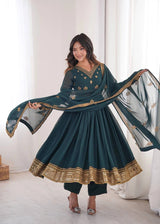
What is a Phulkari Saree? Punjab's Embroidered Heritage
There's a style of embroidery that's so distinctly Punjabi, so alive with color and joy, that just looking at it feels like attending a celebration. That's Phulkari, which literally means 'flower work' in Punjabi. A Phulkari saree is a fabric transformed by centuries-old needlework into something radiant. If you've ever seen a woman in a saree covered in bright geometric flowers made entirely of thread, you've already met Phulkari.
What is a Phulkari Saree? The Meaning
The word comes from two Punjabi words: phul (flower) and kari (work). But if you look at traditional Phulkari, it isn't always literally flowers. The geometric patterns are made with a darn stitch (running stitch in dense rows) done on the reverse of the fabric so the thread shows on the front in clean, flat forms. The effect looks surprisingly modern for a tradition hundreds of years old.
The History of Phulkari
The history of Phulkari embroidery stretches back at least to the 15th century in Punjab, with references in the poetry of the Sufi saint Baba Farid. Practiced across Hindu, Sikh, and Muslim communities, it was one of the few crafts that transcended religious identity.
Historically, Phulkari shawls (odhnis) were created by mothers for their daughters' wedding trousseaux. The craft received a GI (Geographical Indication) tag in 2010. Our traditional sarees pay homage to these regional craft traditions.
Types of Phulkari Work
1. Basic Phulkari
In basic or 'open' Phulkari, the embroidery is scattered across the fabric with space between motifs. The base fabric (usually khaddar or handspun cotton) is visible between embroidered patterns. This is the most common everyday form.
2. Bagh (Garden)
The Bagh variant covers the entire cloth surface with embroidery. No base fabric is visible. A genuine bagh is rare and requires months of work. Only the reverse side reveals the cotton underneath.
3. Thirma Phulkari
Done on a white or off-white cotton base. Traditionally made for brides and symbolizes purity. Red and bright threads on white create a striking contrast.
4. Chope Phulkari
Specifically given to a new bride by her maternal grandmother at the wedding. Made with golden yellow thread on red fabric in a distinctive traditional pattern.
How Phulkari is Made?
Traditional Phulkari uses a darn stitch worked on the wrong side of the fabric. The needle passes under one warp thread at a time, creating long, flat stitches visible on the front. The thread used in traditional Phulkari is untwisted silk floss (pat) from the Sheikpura district of undivided Punjab. This silk gives the embroidery its characteristic flat, shimmering quality, unlike the raised texture of most embroideries.
Phulkari on Sarees Today
Traditionally done on shawls and dupattas, Phulkari sarees are a contemporary adaptation made in two ways:
-
Hand or machine embroidered Phulkari on a ready-woven saree fabric.
-
Woven (jacquard) patterns that mimic the Phulkari embroidery look.
The handmade embroidered version is more valuable. Browse our embroidery sarees for sarees with handcrafted embroidery inspired by traditional techniques.
How to Style a Phulkari Saree?

Traditional Occasions: Weddings, Baisakhi, Lohri
A deep red or bright orange Phulkari saree is perfect for Punjabi festivals like Baisakhi and Lohri. Pair with heavy kundan or polki jewelry. See our Baisakhi sarees and Lohri sarees for festive options.
Contemporary and Casual Events
A Phulkari saree in cotton or georgette with subtle embroidery in a neutral base color is excellent for semi-formal events, cultural programs, and college functions.
Indo-Western Styling
A Phulkari saree styled with a belt at the waist and sneakers is popular among fashion-forward women. The bold geometric embroidery looks unexpectedly modern with contemporary accessories.
How to Care for Phulkari Sarees?
-
Hand washes only in cold water with mild detergent. No scrubbing on embroidered areas.
-
Wash inside out to protect the embroidery from friction.
-
Do not wring. Press gently in a towel to remove water.
-
Dry flat in shade. Hanging can distort the shape.
-
Iron on reverse only. Direct heat flattens and damages silk thread.
Frequently Asked Questions
Is Phulkari embroidery only from Punjab?
Yes. Phulkari is a GI-tagged craft from Punjab. The specific technique, thread, and cultural traditions are distinctly Punjabi.
What is the difference between Phulkari and Bagh?
Phulkari has open spaces between motifs; the base fabric is visible. Bagh covers the entire fabric surface with embroidery, hiding the base completely. Bagh is rarer and more valuable.
How do I know if Phulkari is handmade or machine-made?
Handmade Phulkari has slight irregularities in stitch length and spacing. Machine Phulkari has perfectly uniform stitches. Under a magnifying glass, the difference is immediately clear.